
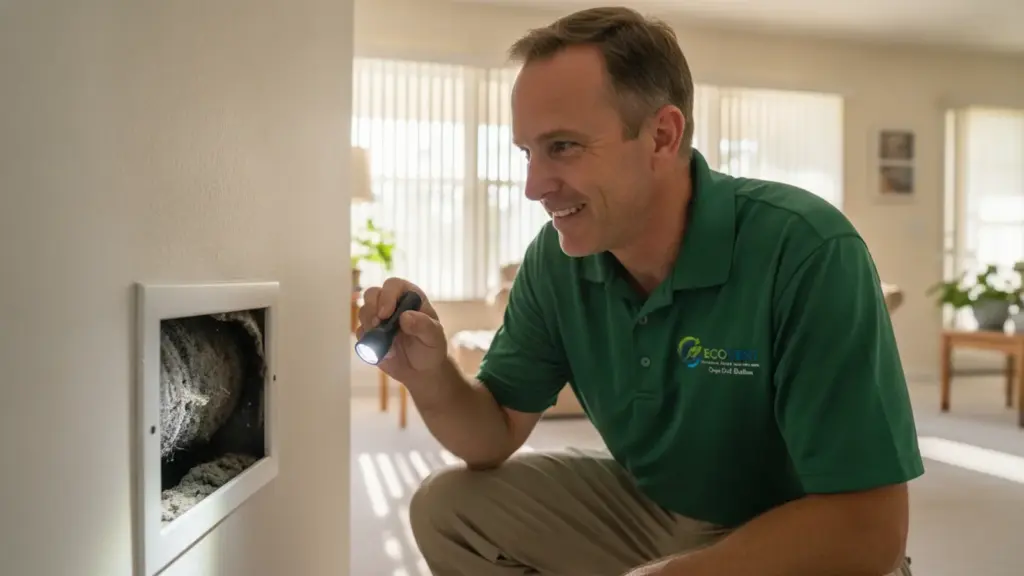
Signs of Mold and Mildew in New Port Richey AC Ducts
What does it mean when your air conditioner starts pushing out a smell that reminds you of a wet towel left in a gym bag? It usually means biological growth has taken hold somewhere inside your duct system. For homeowners in New Port Richey, that scenario is far from rare. Pasco County’s coastal humidity creates near-perfect conditions for mold and mildew to colonize the cool, dark interior of AC ducts, and the signs are often subtle enough to go unnoticed until the problem has been quietly spreading for months.
This guide walks through exactly what those signs look and smell like, why Florida’s climate makes New Port Richey homes especially vulnerable, and what a proper professional cleaning actually does to address the source rather than just masking the odor. If you want the full picture on why musty systems are so common here and how to stop them, see our complete guide to musty air ducts in New Port Richey.
The Scenario Most New Port Richey Homeowners Recognize
Picture this: it’s late June, the windows have been sealed shut for weeks, and you flip on the AC after a warm morning. Within a few minutes, a faint musty odor drifts through the house. You check the trash, the bathroom, the laundry room. Nothing. The smell fades after an hour or so, and you put it out of your mind.
A few weeks later the smell is back, stronger this time, and it seems to follow you from room to room whenever the system is running. That pattern, odor appearing at startup and then cycling through the whole house, is one of the clearest early indicators that something biological is growing inside the ductwork. The cooling system is essentially acting as a delivery mechanism, pulling air across contaminated surfaces and distributing it to every room.
What makes this especially common in New Port Richey is the length of the cooling season. Unlike homes in northern states where the AC runs three or four months a year, systems here run almost continuously from April through October, and many run year-round. That constant operation means condensation forms and reforms inside ducts on a daily cycle, giving any organic material that has settled inside, dust, skin cells, pet dander, pollen, a reliable moisture source to feed on.
Why New Port Richey Homes Are Particularly Vulnerable
New Port Richey sits close to the Gulf of Mexico, and the surrounding wetlands and estuaries keep ambient humidity elevated even on days when it is not actively raining. Average outdoor relative humidity in Pasco County regularly exceeds 70 percent during summer months, and that moisture finds its way into homes through every gap, crack, and door opening.
The housing stock here adds another layer of risk. A significant portion of New Port Richey’s residential neighborhoods were built during the 1970s and 1980s, an era when duct systems were often constructed from fibrous insulation board, sometimes called ductboard, rather than smooth sheet metal. That fibrous interior surface is far more hospitable to biological growth than metal because it holds moisture and provides a textured surface that spores can grip. Older flex duct connections also develop small separations over time, allowing humid attic air, which in a Florida summer can reach temperatures well above 130 degrees with corresponding high humidity, to leak directly into the duct interior.
Newer construction is not immune either. Homes built in the 1990s and 2000s often have ductwork routed through unconditioned attic spaces, and even well-sealed systems experience condensation on the outer surface of cold supply ducts when that cold metal meets hot, humid attic air. If the vapor barrier on the insulation wrapping those ducts has degraded, moisture can work its way inward.
Understanding how the local climate and building characteristics stack the odds helps explain why so many New Port Richey homeowners eventually encounter this problem. It is not a sign of a poorly maintained home. It is a predictable consequence of running cooling equipment in one of the most humid climates in the continental United States.
If you want it handled correctly the first time, consider professional air duct cleaning in New Port Richey.
The Musty Smell in Air Ducts: What It Actually Tells You
Smell is usually the first sign, but it helps to understand what you are actually detecting. The odor associated with mold and mildew in ductwork comes from microbial volatile organic compounds, gases released as biological colonies metabolize organic material. The smell is often described as musty, earthy, or damp, similar to an old basement or a pile of wet leaves.
A few characteristics of the odor help distinguish duct-related growth from other household sources. First, it tends to be strongest at the supply vents themselves, especially in the moments right after the system kicks on, when the first burst of air sweeps across the contaminated surface. Second, it is usually present throughout the house rather than localized to one room, because the duct system distributes air everywhere. Third, it often diminishes after the system has been running for a while, as the initial concentration disperses, only to return at the next startup cycle.
A musty smell that is only in one room, or that seems tied to a specific wall or ceiling area, may point to a localized moisture problem, a slow leak or condensation issue at a particular duct joint, rather than widespread growth throughout the system. Both situations call for a professional inspection, but the distinction matters for understanding the scope of what needs to be addressed.
For a broader look at how Florida’s humidity affects indoor air quality beyond just the duct system, this overview of humidity and indoor air in New Port Richey covers the topic in depth.
Visual Signs: What to Look for at Your Vents and Air Handler
While smell is the most common first signal, there are visible signs worth checking. None of these inspections require you to open up the duct system itself. They are observations any homeowner can make safely from accessible areas.
Start at the supply and return vent covers. Remove a cover and look at the inside surface of the duct opening, the first few inches you can see with a flashlight. Discoloration, particularly dark gray, green, or black spotting on the duct lining or on the back of the vent cover itself, warrants attention. A thin layer of gray-brown dust is normal. Patchy dark staining that wipes off and leaves a stain is not.
Next, check the area around the return air grille, the larger vent that pulls air back to the air handler. Biological growth near the return is significant because it means spores are being actively drawn into the system and redistributed. Streaking or staining on the wall around the grille can indicate that particles are being pulled through gaps in the grille frame.
If you have access to your air handler cabinet, look at the evaporator coil and the drain pan beneath it. The evaporator coil is where refrigerant absorbs heat from the air, and it stays very cold and wet during operation. The drain pan collects condensate and should drain freely. A drain pan with standing water, visible slime, or dark residue is a common source of biological contamination that then gets picked up by airflow and carried into the duct system. This is an area a technician should inspect, but you can often see the drain pan by opening the access panel on the air handler cabinet.
Finally, check the condition of your air filter. A filter that is heavily loaded with dark, clumped material, rather than the uniform gray of ordinary dust, can indicate that particulates from biological growth are present in the airstream. Filters should be changed on a regular schedule regardless, but an unusually dark or discolored filter is worth noting when you call for an inspection.
Many New Port Richey homeowners rely on expert air duct cleaning in New Port Richey for exactly this.
What a Professional Inspection and Cleaning Actually Involves
Identifying the signs is one thing. Addressing the source is another, and this is where professional service matters. A surface wipe-down of vent covers does nothing to the interior of the duct system. Air fresheners and deodorizing sprays mask odor temporarily without touching the underlying growth. The only way to actually resolve biological contamination inside ductwork is to physically remove the material and then address the moisture conditions that allowed it to develop.
A thorough professional duct cleaning for a New Port Richey home typically involves a negative-pressure process: a high-powered vacuum system is connected to the main trunk line, creating suction throughout the duct network, while technicians use agitation tools, brushes, and compressed air whips, to dislodge material from duct walls and drive it toward the vacuum. This is the approach aligned with NADCA standards for residential duct cleaning, and it is meaningfully different from a simple blowout or a vacuum wand inserted a few inches into each vent opening.
After the mechanical cleaning, the technician should inspect the evaporator coil and drain pan, because cleaning the ducts without addressing a contaminated coil or a slow-draining pan simply means the problem recurs. If the drain pan has standing water, clearing the condensate drain line is part of the solution. Some situations also call for an EPA-registered antimicrobial application to duct surfaces after cleaning, though this is a judgment call based on what the inspection reveals rather than a standard add-on for every job.
For homeowners who are weighing the scope and cost of this kind of work, understanding the cost factors for duct cleaning in Pasco County provides a useful breakdown of what drives the price and what questions to ask before booking.
When you are ready to schedule a professional assessment, our air duct cleaning service in New Port Richey is the place to start.
What Happens After a Thorough Cleaning
Homeowners often notice the difference within the first few days after a professional cleaning. The musty odor at startup is typically gone or significantly reduced. The air moving through the system simply smells cleaner, less like a closed-up space and more like neutral, conditioned air.
Beyond the smell, a system that is no longer pushing particulates through the ductwork tends to keep surfaces cleaner. Dust accumulation on furniture and horizontal surfaces often slows noticeably in the weeks after a cleaning, because the duct system is no longer acting as a distribution network for what has built up inside it.
The more important outcome, though, is what does not happen. Biological growth that is allowed to persist and spread can eventually affect duct materials themselves, particularly fibrous ductboard, to the point where cleaning is no longer sufficient and sections need to be replaced. Catching the problem at the contamination stage, before structural damage to the duct material occurs, is almost always less disruptive and less costly than waiting until replacement becomes necessary. For context on what duct replacement involves when cleaning is no longer enough, see what to expect during a residential duct cleaning and inspection.
Ready for the next step? Learn how air duct cleaning services in New Port Richey can help and reach out to the team.
Maintaining the results over time comes down to a few consistent habits. Changing the air filter on schedule, keeping the area around the air handler clear and dry, and having the condensate drain line flushed periodically are all steps that reduce the moisture load inside the system. In a climate like New Port Richey’s, a whole-house dehumidifier or a higher-capacity dehumidification setting on a variable-speed air handler can also make a meaningful difference in how quickly conditions inside the ductwork return to a level that supports biological growth.
Frequently Asked Questions
Can I tell from smell alone whether there is actual mold in my ducts, or could it be something else?
A musty odor is a strong indicator of biological growth, but it is not conclusive on its own. Stagnant water in the drain pan, a dirty evaporator coil, or even a dead pest inside the ductwork can produce similar smells. A professional inspection that includes a visual check of the air handler components and duct interior is the only reliable way to identify the source. The smell is a useful prompt to call for an inspection, not a definitive diagnosis by itself.
Is it safe to keep running the AC while I wait for a cleaning appointment?
Running the system while biological growth is present inside the ducts does distribute particles through the air, but it does not dramatically accelerate the growth itself. If the smell is mild and the system is otherwise functioning normally, continuing to use it while you wait for an appointment is a reasonable choice. If the odor is strong or you notice visible dark staining at multiple vents, getting an appointment scheduled sooner is worth prioritizing.
How often should duct cleaning be done for a New Port Richey home?
There is no single interval that applies to every home, but the combination of Florida’s humidity, long cooling seasons, and older duct materials in many Pasco County homes means that more frequent attention is warranted here than in drier climates. Most homes benefit from a professional inspection every three to five years, with cleaning performed when the inspection reveals meaningful accumulation or biological growth. Homes with pets, residents with respiratory sensitivities, or systems that have had moisture issues may benefit from more frequent service.
Will cleaning the ducts also fix a musty smell coming from the air handler itself?
Not necessarily on its own. If the odor source is the evaporator coil or the drain pan rather than the duct interior, duct cleaning addresses the symptom downstream but not the origin. A thorough service should include inspection and cleaning of the air handler components, not just the duct network. When you describe the symptoms to a technician before they begin, make sure they know the smell seems to originate at startup, which helps them focus attention on the air handler as well as the ducts.
The Bottom Line for New Port Richey Homeowners
A musty smell from your vents is not something to dismiss as a quirk of Florida living. It is a signal that the conditions inside your duct system have shifted from simply dusty to actively supporting biological growth, and that the air your household breathes every day is passing through that environment before it reaches you.
New Port Richey’s climate makes this outcome more likely than in most parts of the country, but it is also entirely addressable. Recognizing the signs early, acting on them with a proper professional cleaning rather than a surface fix, and maintaining the conditions that slow regrowth are the practical steps that keep a cooling system working the way it should.
If the signs described here sound familiar, the next step is a professional inspection. Reach out to schedule one, and get a clear picture of what is actually happening inside your system before the problem progresses further.