
Why Duct Cleaning Is the Missing Piece in New Port Richey Home Dust Control
If you wipe down a surface in your New Port Richey home and the dust is back within a day or two, your cleaning routine isn’t the problem. In Florida’s humid Gulf Coast climate, where windows stay shut for months and the AC runs nearly year-round, your duct system becomes the primary highway for everything floating in your air. This guide explains why residential duct cleaning matters here more than in most parts of the country, what the process actually involves, and how to tell when it’s time to call a professional.
Florida’s Climate Makes Dust Control Harder Than You Think
Sealed Homes and Recirculating Air
Most of the country opens windows in spring and fall to flush out stale air. New Port Richey homeowners don’t get that luxury for months at a time. From late spring through early fall, the combination of heat and humidity keeps homes sealed tight. Your HVAC system is the only thing moving air through the house, which means it’s also the only thing moving dust, pet dander, pollen, and debris from room to room.
Every time the system kicks on, air travels through the return vents, passes through the air handler, and gets pushed back out through the supply registers. Anything that doesn’t get caught by the filter, and plenty of fine particles slip right through standard filters, ends up coating the inside of your ductwork. Over months and years, that coating builds into a layer thick enough to shed particles back into your living space with every cycle.
Humidity’s Role in Dust Accumulation
High relative humidity doesn’t just make the heat feel worse. It creates conditions where dust particles clump together and stick to surfaces, including the interior walls of sheet metal and flex duct. In drier climates, loose dust is easier for a filter to catch on the next pass. In Pasco County’s humid air, that same dust bonds to duct surfaces and stays there, slowly releasing back into the airstream as the system vibrates during operation.
There’s another concern specific to Florida: when warm, humid air meets the cooled surfaces inside an air handler or duct run, condensation can form. Moisture in a duct system, combined with accumulated organic debris, creates conditions where biological growth can take hold. That’s a separate problem from dust alone, and it’s one more reason that routine inspection and cleaning matter more here than in, say, a dry Arizona climate.
The Pet Factor in Sealed Florida Homes
New Port Richey is a pet-friendly community, and a lot of households have dogs or cats that spend most of their time indoors. Pet hair and dander are particularly problematic in sealed homes because they never get a chance to escape. They cycle through the HVAC system repeatedly, and fine dander particles are small enough to bypass many standard filters entirely. Homeowners with pets often notice that no matter how often they vacuum, a fine layer of particulate keeps returning to furniture and floors. In many cases, the duct system is continuously re-depositing what the vacuum just removed.
What Professional Air Duct Cleaning Actually Involves
The Inspection Phase
A thorough job starts before any equipment is turned on. A technician should inspect accessible duct sections, the air handler cabinet, the evaporator coil area, and the supply and return registers. This tells them what they’re dealing with: the type of debris, the condition of the ductwork itself, and whether there are any areas of concern like disconnected sections, visible moisture, or compromised insulation. Skipping this step and going straight to cleaning is how problems get missed.
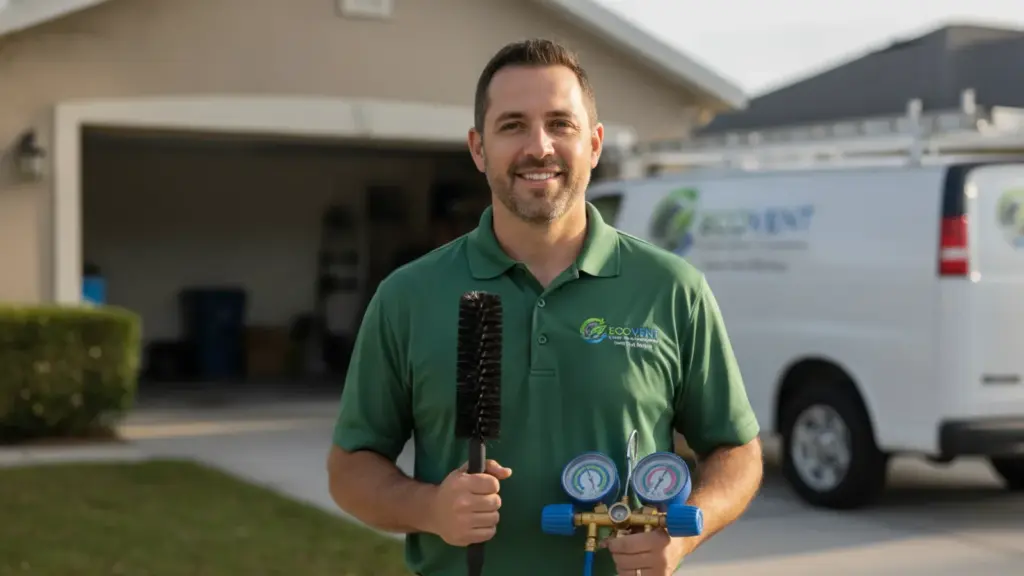
At Ecovent Dryer Duct Solutions in New Port Richey, an inspection is the starting point for every service call. It’s the only way to give homeowners an honest picture of what’s inside their system and what cleaning will realistically accomplish.
Negative Pressure and Agitation: The Core Process
The industry-standard approach to air duct cleaning uses a combination of negative pressure and mechanical agitation. A high-powered vacuum collection unit is connected to the main trunk line, putting the entire duct system under negative pressure. This means that when debris is dislodged from duct walls, it gets pulled toward the collection unit rather than blown back into the living space.
Agitation tools, which may include rotary brushes, air whips, or compressed air skippers depending on the duct material, work through each branch line to knock accumulated debris loose. The sequence matters: technicians typically work from the farthest supply registers back toward the main trunk, then clean the return side separately. Supply registers, return grilles, and the air handler cabinet itself are also addressed. The process for an average home takes several hours when done properly.
What Happens After the Clean
Once cleaning is complete, a technician should do a post-inspection to confirm debris has been removed and that no duct connections were disturbed during the process. They should also check that all access panels are resealed. If any sections of ductwork were found to be damaged, disconnected, or poorly insulated during the initial inspection, that’s a conversation to have before the visit ends. Damaged ductwork undermines everything else: a freshly cleaned system that’s leaking conditioned air into an attic or crawlspace is still costing you money and pulling in unfiltered air.
Signs Your New Port Richey Home Is Overdue for a Cleaning
Visible Clues Around the House
Some indicators are obvious once you know what to look for. Pull a supply register off the wall and shine a flashlight into the duct. If you see a visible layer of dust, debris, or discoloration on the duct walls within the first foot or two, that’s a clear signal. Check the return air grilles as well. A thick grey mat of dust and lint on the grille face means the filter isn’t catching everything, and material is accumulating at the entry point of the system.
Uneven airflow is another clue. If some rooms in your home feel noticeably weaker than others despite having the same register size, partial blockages in the duct runs could be reducing delivery. This is especially common in homes with flex duct that has sagged, kinked, or come partially detached at a connection point.
Performance and Comfort Clues
A system that runs longer than it used to in order to reach the set temperature, or one that short-cycles frequently, often has an airflow problem. Restricted airflow forces the air handler to work harder, which shortens component life and raises energy consumption. A dirty evaporator coil, which accumulates grime when the air passing over it carries debris, is a particularly common culprit in Florida homes because the coil runs cold and wet for so many months of the year.
If you’ve noticed your energy bills creeping up without a clear explanation, and your system is otherwise in good mechanical shape, reduced airflow from debris accumulation is worth investigating. It’s not a guarantee that cleaning will bring bills back down, but it’s a logical place to start the diagnosis.
Time-Based Guidelines
There’s no universal rule that applies to every home, but several factors push a New Port Richey household toward more frequent cleaning rather than less:
- One or more pets that shed
- Occupants who have sensitivities to airborne particulates
- Recent renovation work, which generates drywall dust, sawdust, and other fine debris that gets pulled into the return system
- A home that went through water damage or had visible moisture issues in the duct system
- More than five years since the last professional cleaning (or no prior cleaning on record)
- A newly purchased home where the duct history is unknown
For a typical New Port Richey household without pets or recent renovation, a professional cleaning every three to five years is a reasonable starting point. Homes with pets or other contributing factors often benefit from a shorter interval.
Duct Cleaning vs. Filter Changes: Not the Same Thing
What a Filter Can and Cannot Do
Changing your air filter on schedule is genuinely important, and it’s the single most effective thing a homeowner can do between professional cleanings. A clean filter protects the air handler and coil from debris and captures a portion of airborne particles on each pass. Higher MERV-rated filters capture smaller particles but also restrict airflow more, so the right filter choice depends on your specific system’s design.
If you want it handled correctly the first time, consider professional air duct cleaning in New Port Richey.
What a filter cannot do is clean the duct surfaces that are already coated from years of operation. It also can’t reach debris that has settled in horizontal duct runs, collected around register boots, or accumulated in the air handler cabinet itself. Think of the filter as ongoing maintenance and professional cleaning as periodic restoration. Both matter; neither replaces the other.
A Quick Comparison: Filter Maintenance vs. Professional Duct Cleaning
| Factor | Regular Filter Changes | Professional Duct Cleaning |
|---|---|---|
| Frequency | Every 1-3 months | Every 3-5 years (or as needed) |
| What it addresses | Airborne particles on each pass | Accumulated debris on duct surfaces and in the air handler |
| DIY possible? | Yes | No (requires specialized equipment) |
| Protects the coil? | Partially (when filter is clean) | Yes, coil area is addressed directly |
| Addresses settled debris in ducts? | No | Yes |
| Identifies duct damage? | No | Yes (during inspection phase) |
Duct Condition and When Replacement Makes More Sense
Signs That Cleaning Alone Won’t Solve the Problem
Cleaning restores a duct system that’s fundamentally sound but dirty. It doesn’t fix ductwork that has structural problems. Flex duct that has collapsed, sheet metal that has corroded, or insulated duct with compromised vapor barriers are issues that cleaning can’t address. In older New Port Richey homes, particularly those built before the mid-1990s, ductwork may have reached the end of its serviceable life regardless of how clean it is.
A good inspection will flag these conditions. If a technician finds that a significant portion of the duct system is damaged, disconnected at joints, or has insulation that’s deteriorated to the point of being ineffective, replacement may deliver more lasting benefit than cleaning. Ecovent Dryer Duct Solutions offers both air duct cleaning and duct replacement services, so the recommendation you receive is based on what the system actually needs rather than a one-size-fits-all approach.
The Connection Between Duct Integrity and Dust
A leaky duct system pulls air from wherever it can find it. In Florida homes, that often means unconditioned attic air, which carries heat, humidity, and whatever particulates are floating around up there, gets drawn into the return system through gaps and loose connections. Even a freshly cleaned system with significant leakage will start accumulating debris faster than a well-sealed one. Sealing duct connections and addressing leakage points is part of a complete approach to dust control, not an optional add-on.
Practical Dust Control Steps Between Professional Cleanings
Filter Selection and Replacement Schedule
For most New Port Richey homes, a filter in the MERV 8 to MERV 11 range offers a reasonable balance between particle capture and airflow. MERV 13 and higher filters capture finer particles but can restrict airflow enough to stress the blower motor in systems not designed for that resistance. Check your air handler’s documentation or ask a technician what MERV range your system is rated for before upgrading to a denser filter.
Set a recurring reminder to check the filter monthly. In homes with pets or during high-pollen periods, a filter that’s rated to last three months may need replacement in six weeks. A clogged filter doesn’t just reduce air quality; it starves the system of airflow and can cause the evaporator coil to freeze.
Register and Grille Maintenance
Supply and return grilles are easy to overlook, but they accumulate dust quickly and are simple to clean. Remove them periodically, wash them with warm soapy water, and let them dry completely before reinstalling. While the grille is off, shine a light into the duct opening. You can vacuum the first several inches of accessible duct with a household vacuum and a brush attachment. This won’t substitute for a professional cleaning, but it reduces the amount of loose surface debris near the opening.
Make sure furniture, rugs, and drapes aren’t blocking supply or return registers. Blocked registers create pressure imbalances that reduce system efficiency and can cause debris to accumulate unevenly across the duct network.
Source Control: Reducing What Enters the System
The less debris that enters the duct system in the first place, the slower it accumulates. Regular vacuuming with a vacuum that has a HEPA-rated filter reduces the amount of fine particulate that gets stirred up and pulled into return vents. Grooming pets regularly, using doormats at entry points, and removing shoes at the door all reduce the volume of material that ends up airborne inside the home.
If you’re planning any renovation work, seal return vents with plastic sheeting before work begins. Construction dust is extremely fine, travels far, and can coat duct interiors thoroughly in a single afternoon of drywall sanding. Cleaning up after a renovation without having addressed the ducts first means the system will be redistributing construction debris for months.
Frequently Asked Questions
How long does a residential duct cleaning take?
For most single-story New Port Richey homes, a thorough cleaning takes between two and four hours. Larger homes, two-story layouts, or systems with extensive duct runs take longer. A technician can give you a realistic time estimate after the initial inspection.
Will cleaning the ducts make my home smell different?
Many homeowners notice that musty or stale odors reduce after a cleaning, particularly if the system had accumulated pet dander or debris near the air handler. Results vary depending on the source of the odor. If the smell originates from the duct surfaces themselves, cleaning helps. If it’s coming from another source in the home, cleaning the ducts alone may not fully resolve it.
Is duct cleaning worth it if I just replaced my HVAC system?
Yes, possibly more so. A new air handler connected to old, debris-laden ductwork will start accumulating contamination on its fresh components immediately. Cleaning the duct system before or shortly after a new system installation protects the investment and gives the new equipment the cleanest possible operating environment from the start.
Can I clean my own ducts with a shop vacuum?
You can clean the accessible first few inches near each register, and that’s worth doing. But the interior of duct runs, the main trunk lines, and the air handler cabinet require professional-grade negative pressure equipment to clean effectively. Without that vacuum draw, agitating debris in the duct simply redistributes it rather than removing it from the system.
Does duct cleaning help with dust if I have a dog or cat?
It’s one of the most effective steps for pet-owning households. Pet dander and fine hair accumulate on duct surfaces and get redistributed on every HVAC cycle. Cleaning removes that reservoir of material. Homeowners with pets often notice surfaces stay cleaner longer after a professional cleaning, though the effect is best maintained by also keeping up with filter changes and regular vacuuming.
How do I know if a duct cleaning company is doing the job properly?
Look for a company that starts with a visual inspection, uses negative pressure collection equipment (not just a shop vac), and cleans both the supply and return sides of the system including the air handler cabinet. The NADCA (National Air Duct Cleaners Association) publishes standards for residential duct cleaning that describe what a complete job involves. Ask any company you’re considering whether they follow those guidelines.
Conclusion
Persistent dust in a New Port Richey home is rarely a housekeeping failure. It’s usually a system problem, and the duct network is almost always part of the story. Florida’s sealed-home climate, year-round AC operation, and high humidity create conditions where debris accumulates faster and stays put longer than in most other regions. Professional cleaning addresses what filters and vacuums can’t reach, and a proper inspection tells you whether your ductwork is in good shape or needs more than cleaning to perform correctly. If you’re ready to find out what’s actually inside your system, schedule your air duct cleaning today with Ecovent Dryer Duct Solutions and get a clear picture of what your New Port Richey home’s air is working with.